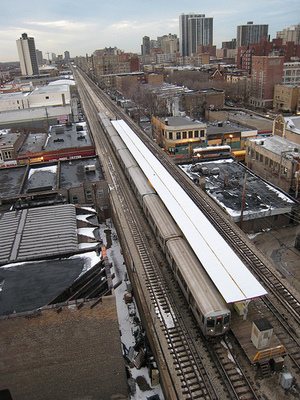
 As the name suggests, transit-oriented development (TOD) is anchored by some form of public transportation, typically a train line. It has been widely accepted as an important planning paradigm to create attractive, livable and sustainable urban environments. The purpose of TOD is to concentrate housing and commercial development close to existing (or occasionally, extended) transit infrastructure, thereby providing an alternative to automobile trips. Most TOD development radiates roughly a half mile – or less than 10 minutes walking distance – from its anchoring rail station.
In the Chicago region, potential sites for TOD are plentiful. The CTA has 142 stations on its seven rapid transit lines along 100 miles of rail, while Metra's suburban service comprises 239 existing stations, with plans for 33 more potential stations through Metra's four current New Starts projects (UP-W Upgrade, UP-NW Extension and Upgrade, new SouthEast Service Line, and new STAR Line), on 11 existing commuter rail lines along 489.2 route miles. TODs can also be anchored by bus stations or terminals, or near major stops along Bus Rapid Transit (BRT) systems.
The remainder of this section describes the general features of TOD and provides local examples of its applications. A systematic assessment of existing and potential TODs in the region is planned to be added to this section at a later date.
TOD and Urban Design
Sep 18, 2013
Transit-Oriented Development
Design Characteristics
In most cases, TOD is made of the design features identified earlier in this paper as general characteristics of urban design and traditional neighborhood development (TND). This paper will focus on three specific design elements:
- Mixed land uses
- Moderate-to-high residential densities
- High-quality walking environments to transit stations
Mixed Land Uses
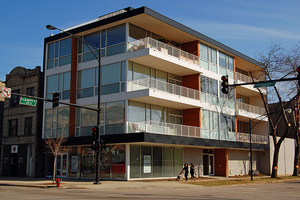
TOD is associated with a mix of land uses that facilitate diverse activities in walkable distances around transit facilities. Compatible, but distinct, land uses located in close proximity decrease people's dependency on automobiles by allowing residents to work or shop near their homes. This also promotes exercise and social interaction on the street.
TOD visioning and planning, TOD zoning and design guidelines, and TOD overlay zones are major planning tools for implementation of this strategy.
Moderate-to-High Residential Densities
In TOD areas, most structures are designed at medium-to-high unit density. Residential density thresholds are often necessary to guarantee a certain population in the area to support local businesses. This is measured by the number of housing units per acre. It can be as low as seven units per acre for bus-based TODs, and ash high as 50 units per acre in larger TODs near a light-rail station. For non-residential uses such as offices, planning guidelines such as Floor Area Ratio (FAR), lot coverage, and building massing are used to control and maintain the density. For instance, Calthorpe (2004) suggests a minimum FAR of 0.35 for nonresidential land uses.
High-Quality Walking Environments
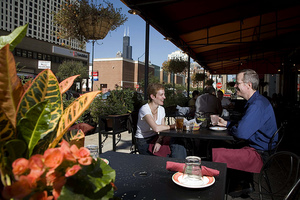
Being pedestrian-friendly is the most significant characteristic of TODs. High-quality walking environments are vital for promoting the use of transit facilities. Easy and nearby access and walking routes, comfortable and enjoyable streetscapes and vibrant and interactive public spaces encourage people to take mass transit instead of relying on private automobiles. Those features of TOD are achieved through good urban design and landscape design. Design elements include sidewalk, building façade, street frontage, etc. Bicycling and parking are also significant in TOD development.
Strategies
In Palatine, the village recently brought 1,000 units of new housing and 200,000 square feet of office and commercial space around its newly renovated Metra station as part of a five-year project. Previously, the station was surrounded by parking lots (Barry and Finkel).
In La Grange, the village's 1986 Master Plan introduced a "transitionary" zoning district to parcels around its rail station to allow for higher uses and greater densities. Additionally, the village established a Tax Increment Financing District (TIF) and renovated its Metra station to help usher in its recent boom of infill development and spiking land values (Cervero).
Blue Island:
A Blue Island TOD project is encouraging development along two Metra rail stops in this aging industrial center, just beyond Chicago's southwest border. The project has been praised – both for its well-informed and inclusive planning process, as well as its rare integration of cargo-oriented development (COD). According to a planner with the Center for Neighborhood Technology (CNT), which lent technical support to the project, it was preceded by an Urban Land Institute (ULI) study that helped convey the importance of TOD to local stakeholders. The study identified locations in Blue Island that would be optimal for both a COD and a TOD development – increasing retail as well as industry and freight rail. The results have reinvigorated an aging downtown and illustrated TOD's potent community development potential.
Elmhurst:
Through a combination of a Tax-Increment Finance district (TIF), a special services area (SSA) and other mechanisms, Elmhurst established the financial foundations necessary to offer incentives to downtown developers and to market the downtown district as a place to live, work, and shop. The City completed a Comprehensive Plan for the community in 1990 which included a Downtown Sector Plan. Subsequent plans included the Central Business District City Centre Planning Study (1999, in conjunction with the RTA), the North Downtown Planning Study (2000), and the Downtown Plan (2006). Out of these planning efforts, high-priority long-range plans emerged encouraging TOD.
Elmhurst worked with both Metra and IDOT to provide infrastructure improvements, most notably the redevelopment of the City's Metra commuter station and funding for parking decks. In other locations in the central business district, the City purchased and assembled land, solicited developers for mixed-use projects via a request-for-proposal process, and made the assembled land available to developers at a reduced cost. Successful TOD-related projects in Elmhurst include: the renovation of York Theater, the construction of over 600 residential units of various types and densities in and near downtown over the last ten years, and the emergence of a "Cultural Campus" in the Wilder Park area that includes a new public library, an expanding arts museum, and Elmhurst College with its ongoing campus master planning. Also, the City has well-utilized parking decks that charge a small fee but are free after 5:00 pm Mondays through Fridays as well as all day on weekends and holidays to promote patronage of the York Theater, shops and restaurants.
One key to the success of TOD projects in Elmhurst is its zoning ordinance. In the early 1990s, the City adopted a new zoning ordinance that re-categorized land uses, protected the designated downtown district, and created transitional zoning that became buffers between areas of different densities and uses. Townhomes help provide a buffer between the downtown district and nearby single-family residential zones, and a flexible commercial zone serves as a transition between the traditional downtown district and more service-oriented commercial establishments to the north.
Evanston:
As part of a greater national trend, the City of Evanston experienced a significant population decline by the 1980s, as middle-class residents moved to more outlying suburbs. To counter this, the city planned for higher residential densities along four of its commuter rail stations and, by 1989, had amended the zoning code to accommodate the density changes and mix of uses. To promote interest in Evanston – and leverage public funds to assist in the new development – the city proposed a library and transportation center, and then a research and technology center for a 22-acre site near a transit station at the north edge of downtown. Tax Increment Finance (TIF) districts were also established along the four transit centers to help fund the redevelopment. The transportation center represented the only regional transfer point outside of Chicago to have commuter and heavy rail service in addition to urban and suburban bus service. The technology center site, which failed to attract many research companies, instead became an entertainment center with a Hilton hotel, an 18-screen movie theater and retail and restaurant options. The entertainment complex set a high-density precedent that the city hoped would spark new development along its 10 rail stations (three Metra stations and seven Chicago Transit Authority stations). By 2005, roughly 2,500 housing units had been added to these transit zones, increasing Metra and CTA ridership by 6% (The population of Evanston increased by 1% over the same period of time). Depending on the station, Metra ridership alone increased by between 60% and 155%, as 32% of Evanston's residents commuted by non-automotive modes. This doubled the 16% non-automotive-commuter average seen in other regional suburbs. Between 1986 and 2004, Evanston's Equalized Assessed Value increased by 191%, allowing for its lowest tax rate since 1971 (Makarewicz and Benedict).
Mundelein:
The Village of Mundelein first sought to create a definitive downtown in its 1995 and 1997 Comprehensive Plans. However, it was not until the 2004 completion of their Transit-Oriented Development Plan, prepared under contract with the Regional Transportation Authority, that this vision began to take shape. The focus area for the plan encompasses a ½ mile radius around the Mundelein Train Station, which serves METRA's North Central Line. The North Central Line was double-tracked in 2005, effectively increasing the ridership that travels through Mundelein. The Transit-Oriented Development Plan looks to capitalize on this increase in pedestrian traffic by creating a walkable downtown in the immediate area around the Mundelein Train Station that is home to a multitude of land uses.
The area that the plan focuses on is characterized by mostly large, vacant lots that are cut off from the grid street system that serves the majority of the community. In constructing the plan, major efforts were made to seek community input on how this land should be developed, which included open house meetings and the creation of a project advisory board (made up of local residents and business owners). Public input was used to create the overall goal of the plan – increase a more coherent and active downtown through increased utilization of transit functions and increases in growth and density in the planning area. To reach these goals, the TOD Plan proposes locating a variety of housing types and retail into the planning area. The plan also proposes the reconfiguration of streets in the area to allow for increased access to local bus routes and a greater sense of connectivity to the community as a whole. Finally, the plan calls for the creation of a "civic campus" that will offer a number of amenities in close range to residents of the downtown area.
To date, the Village of Mundelein has already begun to implement some of the proposals in the TOD Plan. The greatest of all of these accomplishments has been the planned development of Cardinal Square, a townhome and condominium development that will be located adjacent to the Mundelein Train Station. When completed, Cardinal Square will contain nine separate buildings – one building is already completed. This development is imperative to creating a more active downtown, as it will provide the area with a stable residency to provide business to proposed retail and civic uses.
The Bethel Center, Chicago:
For more than 10 years, the elevated train stop at Lake Street and Pulaski Road was surrounded by vacant, crime-ridden properties that deterred ridership and development. By 1992, the Chicago Transit Authority threatened to close the stop – and its greater line – outright. In a disinvested community where roughly 35 percent of the residents owned a car, the "El" provided a vital portal to jobs throughout the city. Recognizing the need for a train line in their community, Bethel New Life, a local faith-based organization, teamed up with other community groups to form the Lake Street El Coalition. After a year of lobbying on behalf of the West Side branch, the coalition succeeded, and the CTA announced that instead of closing the Green Line, it would rebuild it. Yet, Bethel New Life was not finished. The group sought funding from various public and private sources and set about developing the property directly adjacent to the Lake/Pulaski stop. The result is a LEED-certified, mixed-use building that comprises new housing and jobs in a neighborhood that sorely needed both. In a recent report of national best practices, former Bethel New Life President Mary Nelson, who was instrumental in developing the Bethel Center, is as quoted as saying, "We turned a dark, dank corner into a thriving place. This is really an anchor for more redevelopment in the area" (Grady and Leroy, 2006).
Sep 18, 2013
Transit-Oriented Development
As the name suggests, transit-oriented development (TOD) is anchored by some form of public transportation, typically a train line. It has been widely accepted as an important planning paradigm to create attractive, livable and sustainable urban environments. The purpose of TOD is to concentrate housing and commercial development close to existing (or occasionally, extended) transit infrastructure, thereby providing an alternative to automobile trips. Most TOD development radiates roughly a half mile – or less than 10 minutes walking distance – from its anchoring rail station.
In the Chicago region, potential sites for TOD are plentiful. The CTA has 142 stations on its seven rapid transit lines along 100 miles of rail, while Metra's suburban service comprises 239 existing stations, with plans for 33 more potential stations through Metra's four current New Starts projects (UP-W Upgrade, UP-NW Extension and Upgrade, new SouthEast Service Line, and new STAR Line), on 11 existing commuter rail lines along 489.2 route miles. TODs can also be anchored by bus stations or terminals, or near major stops along Bus Rapid Transit (BRT) systems.
The remainder of this section describes the general features of TOD and provides local examples of its applications. A systematic assessment of existing and potential TODs in the region is planned to be added to this section at a later date.
Design Characteristics
In most cases, TOD is made of the design features identified earlier in this paper as general characteristics of urban design and traditional neighborhood development (TND). This paper will focus on three specific design elements:
- Mixed land uses
- Moderate-to-high residential densities
- High-quality walking environments to transit stations
Mixed Land Uses
TOD is associated with a mix of land uses that facilitate diverse activities in walkable distances around transit facilities. Compatible, but distinct, land uses located in close proximity decrease people's dependency on automobiles by allowing residents to work or shop near their homes. This also promotes exercise and social interaction on the street.
TOD visioning and planning, TOD zoning and design guidelines, and TOD overlay zones are major planning tools for implementation of this strategy.
Moderate-to-High Residential Densities
In TOD areas, most structures are designed at medium-to-high unit density. Residential density thresholds are often necessary to guarantee a certain population in the area to support local businesses. This is measured by the number of housing units per acre. It can be as low as seven units per acre for bus-based TODs, and ash high as 50 units per acre in larger TODs near a light-rail station. For non-residential uses such as offices, planning guidelines such as Floor Area Ratio (FAR), lot coverage, and building massing are used to control and maintain the density. For instance, Calthorpe (2004) suggests a minimum FAR of 0.35 for nonresidential land uses.
High-Quality Walking Environments
Being pedestrian-friendly is the most significant characteristic of TODs. High-quality walking environments are vital for promoting the use of transit facilities. Easy and nearby access and walking routes, comfortable and enjoyable streetscapes and vibrant and interactive public spaces encourage people to take mass transit instead of relying on private automobiles. Those features of TOD are achieved through good urban design and landscape design. Design elements include sidewalk, building façade, street frontage, etc. Bicycling and parking are also significant in TOD development.
Strategies
In Palatine, the village recently brought 1,000 units of new housing and 200,000 square feet of office and commercial space around its newly renovated Metra station as part of a five-year project. Previously, the station was surrounded by parking lots (Barry and Finkel).
In La Grange, the village's 1986 Master Plan introduced a "transitionary" zoning district to parcels around its rail station to allow for higher uses and greater densities. Additionally, the village established a Tax Increment Financing District (TIF) and renovated its Metra station to help usher in its recent boom of infill development and spiking land values (Cervero).
Blue Island:
A Blue Island TOD project is encouraging development along two Metra rail stops in this aging industrial center, just beyond Chicago's southwest border. The project has been praised – both for its well-informed and inclusive planning process, as well as its rare integration of cargo-oriented development (COD). According to a planner with the Center for Neighborhood Technology (CNT), which lent technical support to the project, it was preceded by an Urban Land Institute (ULI) study that helped convey the importance of TOD to local stakeholders. The study identified locations in Blue Island that would be optimal for both a COD and a TOD development – increasing retail as well as industry and freight rail. The results have reinvigorated an aging downtown and illustrated TOD's potent community development potential.
Elmhurst:
Through a combination of a Tax-Increment Finance district (TIF), a special services area (SSA) and other mechanisms, Elmhurst established the financial foundations necessary to offer incentives to downtown developers and to market the downtown district as a place to live, work, and shop. The City completed a Comprehensive Plan for the community in 1990 which included a Downtown Sector Plan. Subsequent plans included the Central Business District City Centre Planning Study (1999, in conjunction with the RTA), the North Downtown Planning Study (2000), and the Downtown Plan (2006). Out of these planning efforts, high-priority long-range plans emerged encouraging TOD.
Elmhurst worked with both Metra and IDOT to provide infrastructure improvements, most notably the redevelopment of the City's Metra commuter station and funding for parking decks. In other locations in the central business district, the City purchased and assembled land, solicited developers for mixed-use projects via a request-for-proposal process, and made the assembled land available to developers at a reduced cost. Successful TOD-related projects in Elmhurst include: the renovation of York Theater, the construction of over 600 residential units of various types and densities in and near downtown over the last ten years, and the emergence of a "Cultural Campus" in the Wilder Park area that includes a new public library, an expanding arts museum, and Elmhurst College with its ongoing campus master planning. Also, the City has well-utilized parking decks that charge a small fee but are free after 5:00 pm Mondays through Fridays as well as all day on weekends and holidays to promote patronage of the York Theater, shops and restaurants.
One key to the success of TOD projects in Elmhurst is its zoning ordinance. In the early 1990s, the City adopted a new zoning ordinance that re-categorized land uses, protected the designated downtown district, and created transitional zoning that became buffers between areas of different densities and uses. Townhomes help provide a buffer between the downtown district and nearby single-family residential zones, and a flexible commercial zone serves as a transition between the traditional downtown district and more service-oriented commercial establishments to the north.
Evanston:
As part of a greater national trend, the City of Evanston experienced a significant population decline by the 1980s, as middle-class residents moved to more outlying suburbs. To counter this, the city planned for higher residential densities along four of its commuter rail stations and, by 1989, had amended the zoning code to accommodate the density changes and mix of uses. To promote interest in Evanston – and leverage public funds to assist in the new development – the city proposed a library and transportation center, and then a research and technology center for a 22-acre site near a transit station at the north edge of downtown. Tax Increment Finance (TIF) districts were also established along the four transit centers to help fund the redevelopment. The transportation center represented the only regional transfer point outside of Chicago to have commuter and heavy rail service in addition to urban and suburban bus service. The technology center site, which failed to attract many research companies, instead became an entertainment center with a Hilton hotel, an 18-screen movie theater and retail and restaurant options. The entertainment complex set a high-density precedent that the city hoped would spark new development along its 10 rail stations (three Metra stations and seven Chicago Transit Authority stations). By 2005, roughly 2,500 housing units had been added to these transit zones, increasing Metra and CTA ridership by 6% (The population of Evanston increased by 1% over the same period of time). Depending on the station, Metra ridership alone increased by between 60% and 155%, as 32% of Evanston's residents commuted by non-automotive modes. This doubled the 16% non-automotive-commuter average seen in other regional suburbs. Between 1986 and 2004, Evanston's Equalized Assessed Value increased by 191%, allowing for its lowest tax rate since 1971 (Makarewicz and Benedict).
Mundelein:
The Village of Mundelein first sought to create a definitive downtown in its 1995 and 1997 Comprehensive Plans. However, it was not until the 2004 completion of their Transit-Oriented Development Plan, prepared under contract with the Regional Transportation Authority, that this vision began to take shape. The focus area for the plan encompasses a ½ mile radius around the Mundelein Train Station, which serves METRA's North Central Line. The North Central Line was double-tracked in 2005, effectively increasing the ridership that travels through Mundelein. The Transit-Oriented Development Plan looks to capitalize on this increase in pedestrian traffic by creating a walkable downtown in the immediate area around the Mundelein Train Station that is home to a multitude of land uses.
The area that the plan focuses on is characterized by mostly large, vacant lots that are cut off from the grid street system that serves the majority of the community. In constructing the plan, major efforts were made to seek community input on how this land should be developed, which included open house meetings and the creation of a project advisory board (made up of local residents and business owners). Public input was used to create the overall goal of the plan – increase a more coherent and active downtown through increased utilization of transit functions and increases in growth and density in the planning area. To reach these goals, the TOD Plan proposes locating a variety of housing types and retail into the planning area. The plan also proposes the reconfiguration of streets in the area to allow for increased access to local bus routes and a greater sense of connectivity to the community as a whole. Finally, the plan calls for the creation of a "civic campus" that will offer a number of amenities in close range to residents of the downtown area.
To date, the Village of Mundelein has already begun to implement some of the proposals in the TOD Plan. The greatest of all of these accomplishments has been the planned development of Cardinal Square, a townhome and condominium development that will be located adjacent to the Mundelein Train Station. When completed, Cardinal Square will contain nine separate buildings – one building is already completed. This development is imperative to creating a more active downtown, as it will provide the area with a stable residency to provide business to proposed retail and civic uses.
The Bethel Center, Chicago:
For more than 10 years, the elevated train stop at Lake Street and Pulaski Road was surrounded by vacant, crime-ridden properties that deterred ridership and development. By 1992, the Chicago Transit Authority threatened to close the stop – and its greater line – outright. In a disinvested community where roughly 35 percent of the residents owned a car, the "El" provided a vital portal to jobs throughout the city. Recognizing the need for a train line in their community, Bethel New Life, a local faith-based organization, teamed up with other community groups to form the Lake Street El Coalition. After a year of lobbying on behalf of the West Side branch, the coalition succeeded, and the CTA announced that instead of closing the Green Line, it would rebuild it. Yet, Bethel New Life was not finished. The group sought funding from various public and private sources and set about developing the property directly adjacent to the Lake/Pulaski stop. The result is a LEED-certified, mixed-use building that comprises new housing and jobs in a neighborhood that sorely needed both. In a recent report of national best practices, former Bethel New Life President Mary Nelson, who was instrumental in developing the Bethel Center, is as quoted as saying, "We turned a dark, dank corner into a thriving place. This is really an anchor for more redevelopment in the area" (Grady and Leroy, 2006).